Part 8: Observability as Intelligence (Self-Critique)
Part 8 of our series: "The Agentic Readiness Shift: Building for Autonomous Engineers."
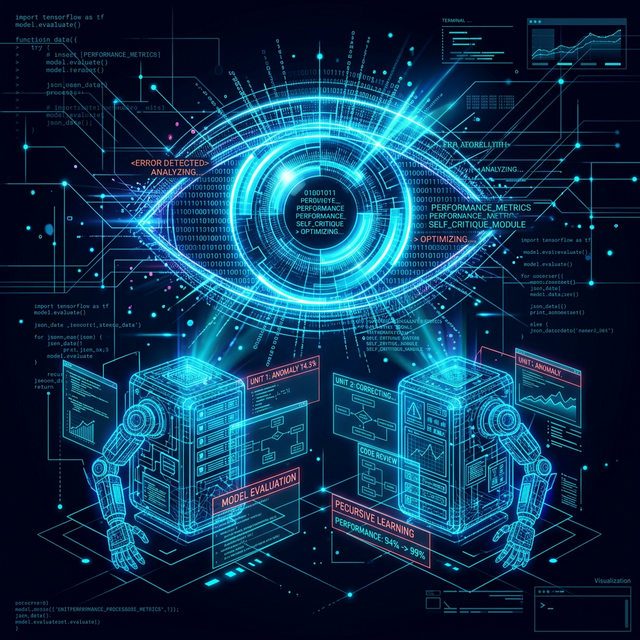
The Feedback Vacuum
In standard DevOps, "feedback" is a human-led process. You deploy code, wait for a user to complain or a dashboard to turn red, and then you decide what to fix. In an autonomous engineering system, this delay is a catastrophic failure. It means the system is acting without understanding the consequences of its actions.
We eliminate this delay through The Reflector—a dedicated agent whose only job is to watch the system fail and understand exactly why.
Autonomous Gap Detection
The Reflector operates by continuously streaming logs and performance metrics. It doesn't just look for "Errors"; it looks for Inconsistencies between intended state and actual performance. This is the heart of Observability as Intelligence.
When it identifies a functional gap—like a resource reaching its limit or a security policy being too permissive—it triggers a Self-Correction Request (SCR).
{
  "gap_id": "ERR_CONCURRENCY_403",
  "evidence": "Lambda 'process-analysis' throttled 12 times in 60s",
  "hypothesis": "Provisioned concurrency insufficient for burst load",
  "mandate": "ARCHITECT_PLAN_MUTATION"
}
Engineering a Conscience
By giving the machine the ability to critique its own execution, we transform it from a tool into a teammate. The Reflector is the engine's conscience, ensuring every mutation is grounded in empirical reality rather than just theoretical reasoning.
Observability is no longer just for humans; it is the sensory input for the autonomous software engineer.
Read the full "The Agentic Readiness Shift" series:
- Part 1: The Agentic Wall (Context Fragmentation)
- Part 2: Beyond the Sidekick (Rise of the Agentic System)
- Part 3: The Economic Moat (Quantifying AI ROI)
- Part 4: The Neural Spine (Event-Driven Orchestration)
- Part 5: Closing the Loop (Git as a Runtime)
- Part 6: Cognitive Tiering (Multi-Headed Brain)
- Part 7: The Resilience Fortress (Designing for Disaster)
- Part 8: Observability as Intelligence (Visualizing the Unseen) ← You are here
- Part 9: Human-Agent Co-Management (The Neural Reserve)
- Part 10: Recursive Safety (Governing the Autonomous Swarm)
- Part 11: Roadmap to Autonomy (From Sandbox to Prod)
- Part 12: The Living Repository (Reflections on the Future)
- Part 13: Evolution ROI (Measuring the Infinite Value)
Join the Discussion
Have questions or want to share your AI code quality story? Drop them below. I read every comment.