Part 10: Recursive Safety (VPCs and Guards)
Part 10 of our series: "The Agentic Readiness Shift: Building for Autonomous Engineers."
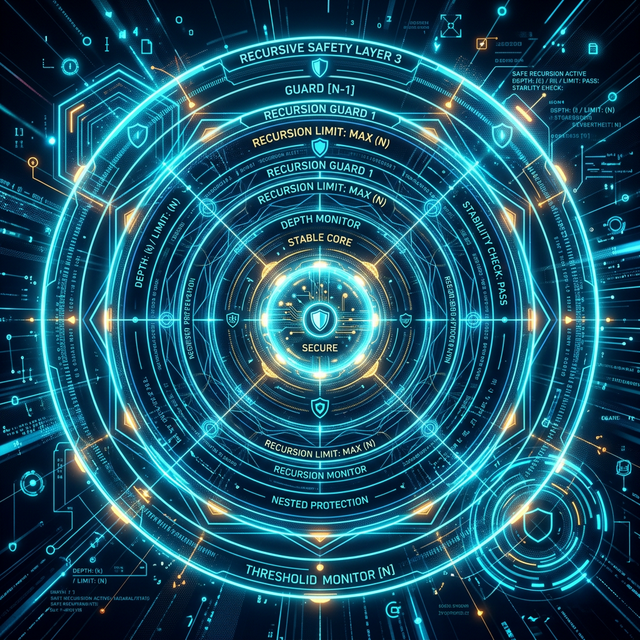
The Fear of the Runaway Loop
The biggest challenge in autonomous infrastructure isn't intelligence—it's Control. If an agent identifies a gap and attempts a mutation that introduces a new gap, you risk a "Recursion Storm" where the machine burns your cloud budget in a circular attempt to fix itself.
In an Agentic Ready environment, we solve this through three non-negotiable safety layers: Recursion Guards, Approval Gates, and VPC Isolation.
The Recursion Guard
Every mutation event is tracked by a global limiter. The Recursion Guard monitors the depth and frequency of mutations per resource. If the engine attempts to mutate the same resource more than a predefined number of times in a short window, the guard pulses a HALT_AND_REFLECT event, locking the resource until a human intervenes.
{
  "Version": "2012-10-17",
  "Statement": [
    {
      "Effect": "Deny",
      "Action": ["rds:DeleteDBInstance", "s3:DeleteBucket"],
      "Resource": "*",
      "Condition": {"Bool": {"aws:MultiFactorAuthPresent": "false"}}
    }
  ]
}
Context Isolation
Safety also means limiting what the agent can "see". By using strict VPC boundaries and IAM roles, we ensure the agent only has access to the resources you have explicitly whitelisted. This Context Isolation prevents the agent from accidentally wandering into production databases or sensitive configuration stores.
Safety isn't about stopping the agent; it's about giving it the freedom to move within a secure fortress.
Read the full "The Agentic Readiness Shift" series:
- Part 1: The Agentic Wall (Context Fragmentation)
- Part 2: Beyond the Sidekick (Rise of the Agentic System)
- Part 3: The Economic Moat (Quantifying AI ROI)
- Part 4: The Neural Spine (Event-Driven Orchestration)
- Part 5: Closing the Loop (Git as a Runtime)
- Part 6: Cognitive Tiering (Multi-Headed Brain)
- Part 7: The Resilience Fortress (Designing for Disaster)
- Part 8: Observability as Intelligence (Visualizing the Unseen)
- Part 9: Human-Agent Co-Management (The Neural Reserve)
- Part 10: Recursive Safety (Governing the Autonomous Swarm) ← You are here
- Part 11: Roadmap to Autonomy (From Sandbox to Prod)
- Part 12: The Living Repository (Reflections on the Future)
- Part 13: Evolution ROI (Measuring the Infinite Value)
Join the Discussion
Have questions or want to share your AI code quality story? Drop them below. I read every comment.